
TEACHER BUSINESS
How to Start a Side Business as a Teacher (While Still Teaching)
You love teaching, but the salary schedule doesn’t love you back.
Somewhere between grading papers and your third cup of coffee, you’ve probably wondered how to start a side business as a teacher without quitting the classroom, losing your mind, or surviving on four hours of sleep.
Plenty of teachers are already doing this. They aren’t hustling 80-hour weeks. They’re building something small and sustainable around the hours they actually have. This guide walks through how.
Why Teachers Make Great Entrepreneurs
Teachers walk in with an unfair advantage:
- You explain complex things simply. That’s marketing.
- You manage 30 humans with competing needs. That’s operations.
- You plan, assess, and adjust constantly. That’s product development.
- You already create resources your colleagues beg to borrow. That’s inventory.
- You understand your customer better than any MBA ever could, because you are your customer.
The skills aren’t the obstacle. For most teachers, the obstacle is getting comfortable with the idea that a teacher is allowed to be a business owner. You are.
How to Start a Side Business as a Teacher in 6 Steps
Step 1: Audit your actual hours (be brutally honest)
Forget the fantasy 20-hour side hustle week. Track one real week: teaching, grading, family, rest, everything. Most full-time teachers find 5-10 genuinely usable hours per week. That’s your budget. Every decision below has to fit inside it. A business built on hours you don’t have is a business that dies by October.

Step 2: Pick a business model that fits your hours
Not all teacher side business ideas are equal when you’re teaching full time. Match the model to your reality:
- 5 hours/week: digital templates or resources (make once, sell repeatedly), freelance curriculum writing (flexible deadlines)
- 5-8 hours/week: tutoring or coaching (scheduled, contained sessions), a small service offer
- 8-10 hours/week: building an online course, growing a content channel, launching a workshop
One rule guides all of this: pick the model with the least ongoing time per dollar. A digital template you build once and sell 200 times beats a service that eats every Tuesday night forever.
Step 3: Validate before you build anything
This is where most teacher businesses die: building something nobody asked for. Before you spend a single weekend creating:
- Ask 10 teachers what they’d pay to solve
- Post the idea in a teacher Facebook group and watch the reactions
- Pre-sell it: “I’m making X, founding members get it for $Y.” If nobody buys, you just saved yourself 40 hours
Ten conversations. That’s the whole validation process. Don’t skip it.
Step 4: Build the smallest sellable version
Your first offer should embarrass you slightly with its simplicity. Examples:
- One digital game template, not a 50-template bundle
- A 60-minute live workshop, not a 12-module course
- Five tutoring slots, not a full coaching program
Launch small, get paying customers, learn what they actually want, then expand. Perfectionism is procrastination in a cardigan.
Step 5: Set up the leanest tech stack
You need four things, not forty:
- A way to be found: a simple website (one page is fine to start)
- A way to take money: Stripe, PayPal, or a basic shop setup
- A way to deliver: email delivery, Google Drive links, or a simple download page
- A way to stay in touch: an email list (start this on day one, not day 100)
You don’t need a funnel, a webinar platform, a course host, or branding guidelines. Add tools when revenue justifies them, not before.
Step 6: Protect your teaching energy
Your classroom job funds this whole operation, and it’s the source of your credibility. These are non-negotiable:
- Set business hours (e.g., Sunday afternoons + two weeknights) and defend them like a planning period
- Batch your work: content creation one day, admin another; task-switching is where evenings go to die
- Take one full day off per week from the business. You need the rest to keep this going long term
- Use school breaks strategically: summers and holidays are your build seasons; the school year is maintenance mode
Perfectionism is procrastination in a cardigan.
Teacher Side Business Ideas That Fit Full-Time Teaching Hours
Ranked by how well they respect your schedule:
Lowest ongoing time commitment:
- Digital templates and classroom resources (build once, sell for years)
- Print-on-demand teacher merch (design once, platform handles the rest)
Medium time commitment:
- Freelance curriculum writing or editing (project-based, flexible deadlines)
- Virtual tutoring (scheduled, high hourly rate, contained hours)
Higher time commitment (but higher upside):
- Online courses and workshops (big upfront build, then scalable)
- Coaching new teachers (recurring revenue, relationship-driven)
- Content creation: YouTube, Instagram, blog (slow to monetize, compounds over time)
Start where your hours are. You can always graduate to a bigger model later.
Validate Before You Build: The 2-Week Test
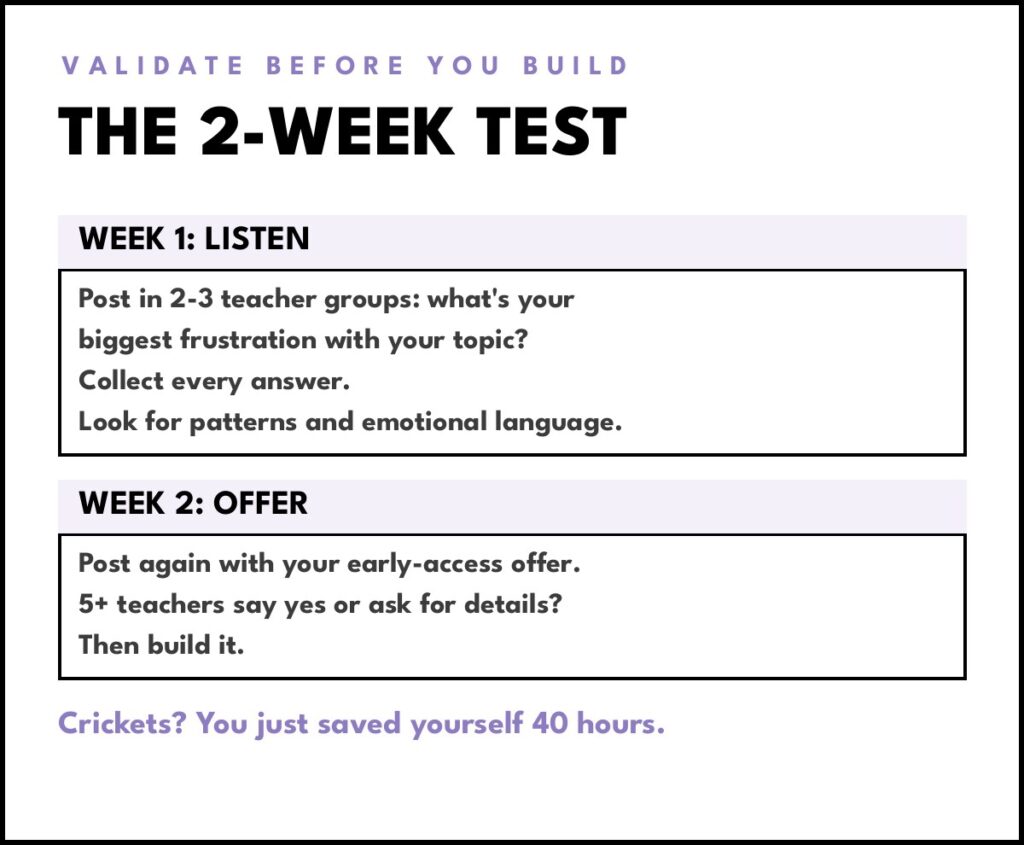
Here’s a concrete validation sprint you can run without building anything:
Week 1: Listen. Post in 2-3 teacher groups: “Quick question: what’s your biggest frustration with [topic]?” Collect every answer. Look for patterns and emotional language (“I dread,” “I waste hours on”).
Week 2: Offer. Post again: “I’m thinking of creating [specific solution]. Would anyone want early access for [price]?” If 5+ teachers say yes or ask for details, build it. If it’s crickets, you just saved yourself 40 hours. Pick a different problem.
Real demand sounds like “shut up and take my money.” Everything else is politeness.
A Realistic Timeline (No Guru Nonsense)
- Month 1: Validate the idea, talk to teachers, pick your model
- Months 2-3: Build the smallest version, set up the lean tech stack, start your email list
- Month 4: Launch to a small audience. Expect modest sales. This is normal.
- Months 5-6: Gather feedback, improve the offer, make your first consistent sales
- Months 6-12: Refine, expand what’s working, grow the email list steadily
Anyone promising you five figures in 90 days on teacher hours is selling you something. A real teacher side business takes 6-12 months to find its footing, and that’s fine.
How to Run a Side Hustle for Teachers While Teaching Full Time (Without Burning Out)
Burnout is the #1 killer of teacher side businesses: not competition, not tech, not “saturation.” Protect yourself:
- One project at a time. The template shop AND the course AND the YouTube channel is how you burn out by November. Finish one thing.
- Revenue first, audience second. A small email list of buyers beats 10,000 followers who never pay. Sell early.
- Automate the boring parts. Email sequences, delivery, scheduling: set them up once and stop doing them manually.
- Know your season. Report card season? Business goes on maintenance mode. Summer? Build season. Work with the school calendar, not against it.
- Quit what isn’t working. Six months of crickets is data, not failure. Adjust the offer, not your sense of your own worth.
Frequently Asked Questions
Are teachers allowed to have a side business?
Generally, yes, but check your specific district’s policy and your contract first. Most districts allow outside employment with common-sense guardrails: it can’t interfere with your teaching duties, you usually can’t use school resources or time for the business, and some districts restrict selling directly to your own students or their families. A few require disclosure of outside employment. This isn’t legal advice. Read your contract, ask HR if you’re unsure, and keep the business clearly separate from the classroom. Thousands of teachers run businesses without any issue.
How many hours a week does a teacher side business actually take?
To start: 5-10 hours a week is realistic and enough. To maintain: many established teacher businesses run on 3-5 hours a week once systems are in place. The trap is the launch phase. Building your first product always takes longer than you think. Budget double the time you estimate, and give yourself school breaks as build seasons.
Should I tell my principal or colleagues about my business?
That’s your call, and there’s no requirement to announce it in most districts (again, check your contract). Many teachers keep it quiet at first and share once it’s established. One practical tip: be mindful about selling to colleagues or using school channels to promote. Keep it professional, keep it separate.
What’s the fastest teacher side business to start?
Services. Tutoring, freelance curriculum writing, or a small coaching offer can generate income within weeks because there’s nothing to build, just your expertise and a booking link. Digital products take longer upfront but keep paying you afterward. Pick speed or scalability based on what you need right now.
Do I need an LLC or business license?
Not on day one. Most teachers start as sole proprietors (which requires no paperwork in most places) and formalize later once revenue justifies it. When you’re consistently earning, talk to an accountant about whether an LLC makes sense for your situation. Don’t let paperwork become procrastination.
How do I find time during the school year?
You don’t find time for this. You assign it. Pick 2-3 fixed weekly slots (Sunday afternoon, two weeknights) and treat them like classes you can’t cancel. Batch similar tasks. Lower your standards for everything non-essential during launch season. And remember: summers exist. Many teacher businesses are built in July and maintained September through May.
Get Weekly Teacher-Business Tips in Your Inbox
After watching hundreds of teachers build businesses, the pattern I see is consistent: the ones who make it keep going, one small step a week, even during report card season. It usually isn’t about being the most talented or the most tech-savvy.
Join my email list and I’ll send you one practical teacher-business tip every week. Real strategies, real numbers, no guru fluff, the kind of advice I wish someone had given me when I was building my first offer between grading papers.