
TEACHER BUSINESS
How to Sell Lesson Plans Online: The 2026 Guide for Teachers
You’ve spent years perfecting lesson plans at your kitchen table on Sunday nights.
The hooks that actually engage. The activities that work with real kids, not imaginary ones. The assessments that tell you what they really learned.
Nobody mentioned this in your teacher prep program, but that stack of lesson plans is inventory. If you’ve ever wondered how to sell lesson plans online, this guide covers where to sell, what buyers want, how to price it, and how to protect what’s yours.
You don’t need a business degree, a fancy website, or a massive following. Your teaching experience and a plan will do.

Where to Sell Lesson Plans Online
When teachers decide to sell lesson plans online, the first question is always “where?” There are three main options, each with trade-offs.
Teachers Pay Teachers (TPT)
TPT is the biggest marketplace for teaching resources. Millions of teachers shop there every month, so you get built-in traffic you don’t have to generate yourself. For a brand-new seller, that foot traffic matters.
The trade-offs: marketplaces take a cut of every sale, and fee structures, rules, and seller tiers change over time. Always check the current seller terms before you build your pricing strategy. You’re also building on rented land. TPT controls the search algorithm, the customer relationship, and the rules.
Best for: getting your first sales quickly and learning what buyers actually want.
Your Own Website
Selling from your own site means you keep more of every sale, control the whole customer experience, and own the customer relationship. No algorithm decides whether buyers find you.
The trade-off is traffic. Nobody stumbles onto your website by accident, so you’ll bring buyers yourself through content, social media, or an email list.
Best for: sellers who want long-term control and higher margins, especially once they have an audience.
Etsy
Etsy shines for certain teacher products: classroom decor, planners, printable games, bulletin board sets. Shoppers arrive in buying mode, and the platform handles all the tech.
The trade-off: Etsy buyers aren’t hunting for curriculum the way TPT shoppers are. A full Civil War unit will struggle there; a gorgeous set of printable morning tubs will do well.
Best for: printables, planners, decor, and giftable teacher products.
Most successful sellers eventually use more than one channel. Start where the buyers already are, then expand to your own site as your audience grows.
The Decision Every TPT Seller Has to Make Before 2027
If you’re selling on TPT (or about to start), there’s a date to circle: January 1, 2027. That’s when TPT’s seller tiers split into Exclusive and Basic, and sellers have to choose which one they’re on before the end of 2026.
Here’s the short version:
Exclusive means your digital resources live only on TPT. In exchange, you get the higher payout rate, and there’s an annual fee of $59.95 to be in the program. On a $10 resource, an Exclusive seller takes home about $7.75.
Basic means you’re free to sell the same resources on your own website or other platforms too. No annual fee, but the payout per sale is lower. That same $10 resource nets a Basic seller about $5.20.
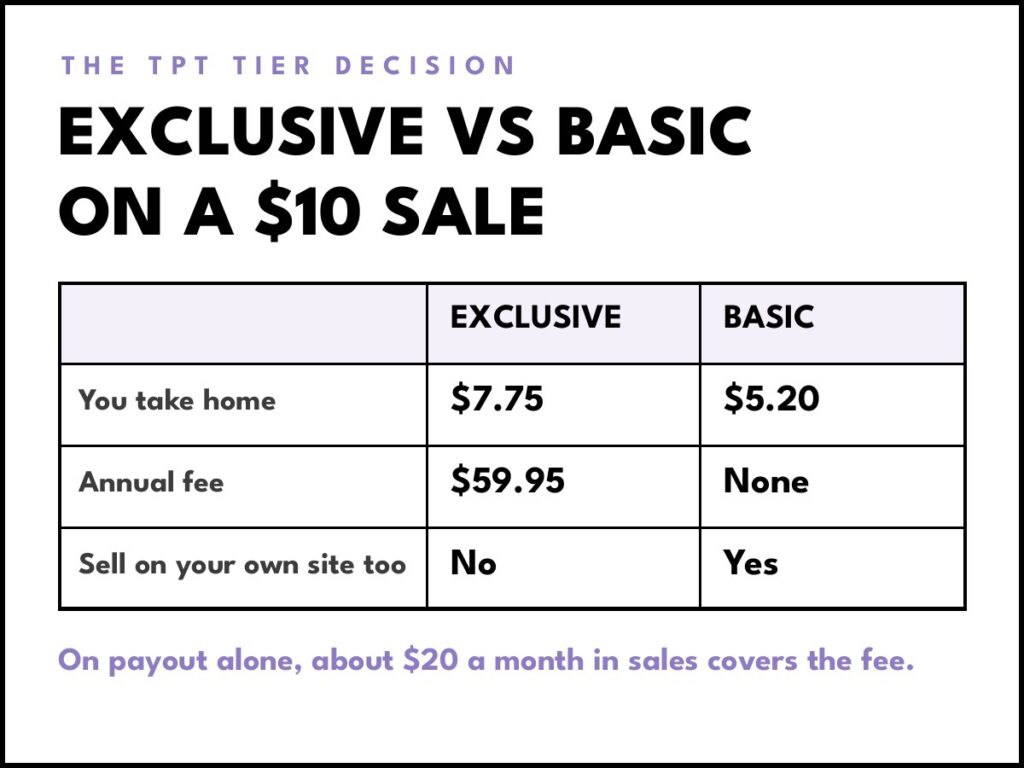
So which one is right? Run your own numbers, but here’s the honest math: on payout alone, Exclusive pulls ahead at a surprisingly low bar, roughly $20 a month in sales covers that annual fee, because the per-sale gap adds up fast. If payout were the only factor, almost everyone would pick Exclusive and call it done.
Payout isn’t the only factor, though. The real cost of Exclusive is giving up the option to sell your own work anywhere else. If you’re planning to build your own shop, grow an email list that buys directly from you, or just keep your options open, that freedom can be worth far more than the payout gap. And choose carefully: if you leave Exclusive for Basic after January 1, there’s a one-year wait before you can rejoin Exclusive.
A few exceptions worth knowing: some product types sit outside the exclusivity rules: Boom Cards, clip art and fonts, physical products, and Kindle books can still be sold elsewhere, and so can courses and professional development, which means a course business like a training or academy stays yours to sell on your own site. Free resources you give away to grow your email list are still allowed either way, with one catch: if a resource is free off TPT, you can’t charge for that same resource on TPT.
Don’t let the tier decision stop you from starting. Pick the tier that matches where your business is headed, not just where it is today, and if you’re dreaming about your own shop someday, that’s your answer.
(Numbers reflect TPT’s published seller terms as of October 2026, as the rest of this guide says, always check the current terms before you finalize your pricing.)
What Sells Best on TPT (and Beyond)
Every new seller asks this, and the answer is simple: resources that solve a specific, painful problem sell. Think like a tired teacher at 9 PM on a Sunday:
- Done-for-you units and bundles: full novel studies, math units, science units. Teachers pay for their weekends back.
- Test prep and review games: anything that makes the boring stuff engaging. Interactive review games are perennial bestsellers.
- Sub plans and emergency plans: the purchase teachers make without hesitating.
- Seasonal resources: Halloween math centers, Black History Month units, end-of-year activities. Seasonal resources sell because the need is immediate.
- Intervention and differentiation materials: small-group resources, remediation packets, enrichment tasks.
- Digital and interactive formats: Google Slides games, self-checking activities. The classroom keeps going digital, and buyers follow.
Notice what’s missing? Generic worksheets. The market rewards specificity. “Fractions worksheets” is a commodity; “Fraction Escape Room for 4th Grade Test Prep” is a product.
Pro tip: Before creating anything new, search your chosen marketplace for the topic. If the top results look outdated or thin, you’ve found a gap. If 500 polished results already exist, pick a narrower angle.
Pricing Basics: Don’t Race to the Bottom
New sellers almost always underprice. Keep these in mind:
- Price the problem, not the pages. A 10-page sub plan that saves a teacher’s sick day is worth more than a 50-page packet of filler. Buyers pay for outcomes.
- Study comparable resources. Find 5-10 similar products, note prices and review counts, and position yourself in the same neighborhood, not the bargain bin.
- Bundle to raise order value. Sell the single lesson for $4 and the full unit for $18. Bundles feel like a deal and increase what each buyer spends.
- Raise prices as reviews come in. Early sales earn reviews; reviews earn the right to charge more. Revisit pricing every quarter.
- Account for marketplace cuts. Platforms take a percentage that changes over time. Verify current terms and price so your take-home makes sense.
The biggest pricing mistake is pricing years of expertise like they’re worth $1.50.
The biggest pricing mistake is pricing years of expertise like they’re worth $1.50.
Protecting Your Work
The unsexy but essential part: keeping your creations yours.
- You own what you create: with one big caveat. Check your district’s policy and your contract first. Materials made on your own time with your own tools are generally yours, but some districts claim work produced on contract time. Know before you sell.
- Flatten your PDFs. Never upload editable source files as the customer-facing product unless you’re intentionally selling an editable template.
- Add a terms-of-use page to every product: classroom use yes, redistribution no, commercial use only if you allow it.
- Watermark preview images so your cover can’t be screenshot-stolen from the listing.
- If someone steals your work, marketplaces have infringement reporting processes. Document everything and file.
- Back up your store itself. Your listings, descriptions, and product images took a long time to make, and they sit on a platform you don’t control. Keep a copy somewhere that’s yours. I built a free tool for this. Store Backup Studio puts together a spreadsheet of your listing information and a visual library of your product images in a few minutes, right in your browser. Nothing uploads to my servers.
A little prevention here saves enormous headaches later.
The Move Most Sellers Skip: Own Your Audience
If all your buyers live on someone else’s platform, your business lives on someone else’s platform. Algorithms change. Fee structures change. Seller tiers change. Your email list doesn’t.
From day one, give buyers a reason to join your world: a free resource library for subscribers, genuinely useful emails with teaching tips and new product alerts, real behind-the-scenes peeks. Your list doesn’t need to be big to be useful. A few hundred engaged teacher subscribers will outperform ten thousand silent followers every time.
Frequently Asked Questions
What sells best on TPT?
Resources that solve specific, urgent problems: complete units and bundles, test prep and review games, sub and emergency plans, seasonal resources, intervention materials, and digital interactive formats. Specificity beats generality. “Fraction Escape Room for 4th Grade” outsells “fractions worksheets” every time.
Can I sell my resources on my own website too?
In most cases, yes. Many sellers run a marketplace shop and their own site at the same time. Just note that some marketplace seller tiers and programs carry exclusivity conditions, so read the current terms of any program you join before listing the same products in two places.
Do I need a business license to sell lesson plans online?
It depends on where you live and how much you earn. Many sellers start as sole proprietors with no special license, but requirements vary by state and country. Once sales become consistent, talk to a tax professional. It’s a good problem to have.
Can I sell resources I originally made for my own classroom?
Usually yes, as long as you created them on your own time and your district contract doesn’t claim them. Strip out anything district-specific and give everything a fresh, professional polish before listing.
How long until I make my first sale?
It varies. Sellers with polished listings in high-demand niches sometimes sell within days; others spend weeks tweaking titles, covers, and previews. Treat the first month as market research, not a verdict. The sellers who do well are the ones who keep adjusting.
What if my district finds out I’m selling resources?
Selling teaching resources is a completely legitimate side business that thousands of teachers run openly. Just make sure the materials are yours to sell, don’t work on it during contract hours, and keep classroom and business social media sensibly separated if that feels safer.
Should I choose TPT Exclusive or Basic?
If TPT is your only storefront and you sell more than about $20 a month, Exclusive’s higher payout usually wins on math alone (about $7.75 vs. $5.20 on a $10 resource, minus the $59.95 annual fee). If you sell (or plan to sell) on your own website too, Basic keeps that door open. Decide before the end of 2026: the tiers take effect January 1, 2027, and leaving Exclusive after that comes with a one-year wait to rejoin.
Ready to Turn Your Lesson Plans Into Real Income?
You already have the hardest part: the expertise and the materials. What you need now is the roadmap: which platform to start on, how to list for visibility, how to price with confidence, and how to grow from first sale to steady income.
That’s exactly what my Teacher Course Academy walks you through, step by step, built specifically for teachers, in teacher language, with zero corporate fluff.