INSTAGRAM GROWTH
How to Grow on Instagram as a Teacher (and Turn Followers Into Buyers)
You don’t need more followers to be successful.
What you need is not a bigger audience size, but a true community.
If you’ve been posting consistently, putting real time into your content, and then checking your Insights to find… not much, you’re not alone. That gap between effort and results is where most teacher sellers get stuck, and it’s rarely an effort problem. It’s usually a few fixable mistakes: content with no clear job, a profile Instagram can’t categorize, and a feed full of followers who were never going to buy anything.
This guide covers the fix in the order it actually works. How Instagram decides who sees your posts. How to make yourself findable. What to post, and what to stop posting. And how followers turn into a community, and then into buyers. Teacher to teacher, no hacks.
The Whole System at a Glance
Growing on Instagram as a teacher comes down to three things: be easy to find with Instagram SEO, post with intention (growth, nurture, or money-making), and turn followers into a community that trusts you enough to buy.
Here’s the process, start to finish. Each step gets its own section below:
- Know how Instagram decides who sees you
- Make yourself findable with Instagram SEO
- Post with intention, not just to post
- Give every post a job: growth, nurture, or money-making
- Build a community, not just an audience
- Stop doing the things that quietly suppress you
- Turn trust into sales, and move people to your email list
There’s No Single Instagram Algorithm (And Why That’s Good News)
The biggest misconception about Instagram is that one almighty algorithm controls everything. There isn’t one. Feed and Stories run on one ranking system, Explore runs on another, Reels on another, and each one weighs different signals.
What the systems have in common is the question they’re trying to answer: what is this person likely to do with this post? Watch it through, comment on it, save it, tap over to the profile, send it to a friend. The more likely someone is to do those things, the more widely the post gets shown. Watch time on video carries real weight, because finishing a video is a strong sign the content was worth someone’s attention. So do sends, because people pass along things they genuinely liked. The systems also sort accounts and content by topic, which is why the next section matters so much.
None of this requires gaming anything. It means Instagram is built to push content toward the people most likely to care about it. Your job is to make it very clear who your content is for and to give people reasons to watch, save, comment, and share. That’s learnable, and it’s the same job in every section that follows.
Instagram SEO: How Teachers Actually Get Found
Instagram SEO is the strategy you use to be easily discovered on Instagram, and to help Instagram categorize your content so it reaches the right teachers.
SEO sounds technical. It isn’t. Instagram SEO is simply the strategy you have in place to be easily discovered, and just as importantly, to help Instagram categorize you so it knows who to show your content to.
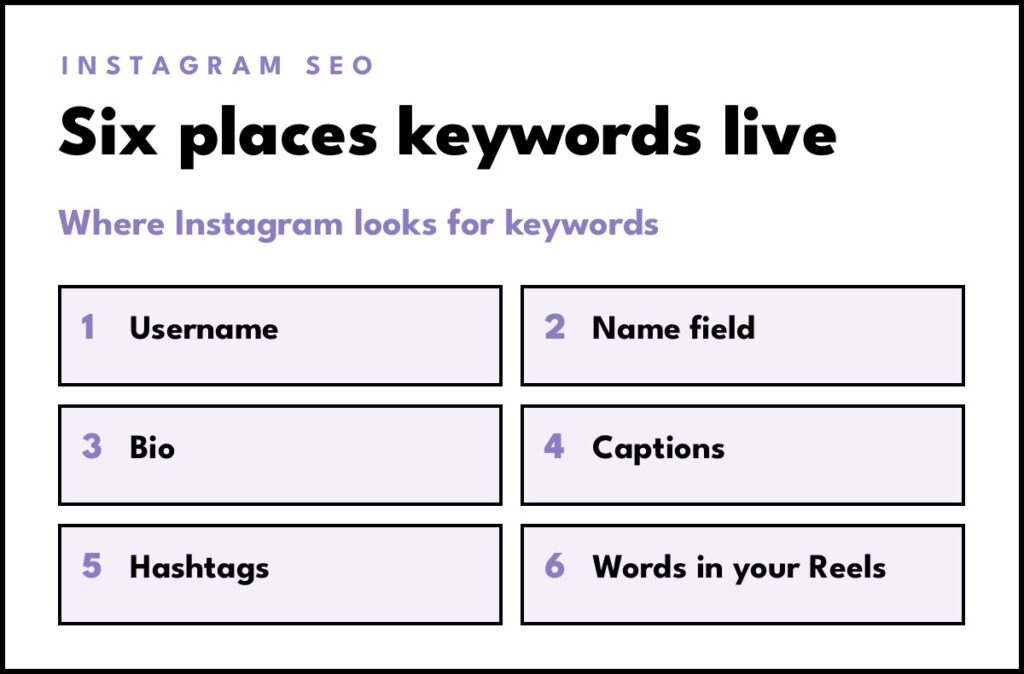
The strategy is keywords. What is your niche? What do you want to be known for? Those words and phrases should live all over your profile:
- Your username. Clear beats clever. A username that says who you are and what you do, like TeachWithEmily, categorizes you at a glance.
- Your name field. The bold line on your profile. “Emily, Teacher and Curriculum Creator” tells both teachers and Instagram exactly what this account is.
- Your bio. “Creating resources to make teaching a breeze” puts her role and her audience in one line.
- Your captions. Phrases like “engaging lesson plans,” “easy ways to teach,” and “classroom management tips” are the words teachers actually type into search.
- Your hashtags. A few specific ones that describe the post, like #mathresources or #teachingmath on a math activity.
- Your Reels. The words you say out loud and the text you put on screen count too.
Instagram search doesn’t work as well as Google’s, and that was never the whole point. When “teacher” and the words around your niche show up consistently across your profile, Instagram has no trouble figuring out who your content belongs in front of.
One of my students updated her profile using this same approach, and she started gaining new followers because she became easily discoverable. Instagram knew who to show her content to. That’s the whole mechanism: clear keywords in, correct audience out.
Set Up a Profile That Earns the Follow
Before any of this works, your profile has to convert a curious visitor into a follower in a few seconds. People decide that fast.
Use a photo of your face as your profile picture. Teachers follow people, and a face tells them there’s a person behind the resources. Then treat your bio like your business card, because that’s what it is. Say what you help with and who it’s for, plainly enough that the right teacher knows she’s in the right place.
After that, set up the rest of your profile around one main goal. You can want growth, engagement, and sales at the same time, but your tactics should serve one of them first:
- If your goal is sales: pin posts at the top of your grid that introduce who you are, what you teach, and what you offer. Put a clear call to action in your bio pointing to a freebie, a resource, or a product. Build highlights that lead somewhere, like a free resource or your best-selling product.
- If your goal is engagement: spend time with the followers you already have. Comment on their posts, reply to every comment on yours, and talk in DMs. Then check your analytics and sort by engagement. Your top posts are telling you what your audience wants more of.
- If your goal is growth: short video is still how new people find you, so lean into Reels. Treat every Reel like it’s someone’s first time seeing you, end with a reason to follow, and engage with accounts that don’t follow you yet.
Copying a tactic that serves a different goal than yours is how teachers end up busy and frustrated. Pick the goal first. The tactics get obvious after that.
Post With Intention, Not Just to Post
Posting every day and posting with intention are not the same thing. One fills a calendar. The other builds a business.
Start with a question: does this post relate to my niche and my ideal audience? Say you’re an economics teacher who sells economics resources, and you post a photo of your very cute Boston Terrier. People will like it. Some will follow for the dog. None of them are there for your resources, which means that growth is busywork. It looks like progress and does nothing for your business.
Intention also means deciding what your content is for. If you’re a business owner, content is a means to an end: it markets what you sell. If you’re a creator, the content itself is the product. Most teacher sellers are business owners, and your posts should behave that way. They exist to help your audience and point them, eventually, toward what you offer.
That does not mean selling in every post. Trust is the number one strategy that will sell your product. Most of your posts should solve a problem or fill a need for the teacher you want to reach: a tutorial showing one of your resources in action, a tip about the topic your audience struggles with, a relatable story about a resource that changed how a lesson landed. When you do post about a product, it lands as a conversation instead of an ad, because the trust is already there.
One of the easiest ways to build that trust is the food court sample. At the mall, you walk the food court, take the free samples, and the moment you taste the one you love, you get in line. A free resource works the same way. A teacher tries it, it fixes a real problem in her classroom, and now she believes your paid resources will too. Give a small piece away on purpose.
We are creating content for people, not algorithms.
Give Every Post a Job: Growth, Nurture, Money-Making
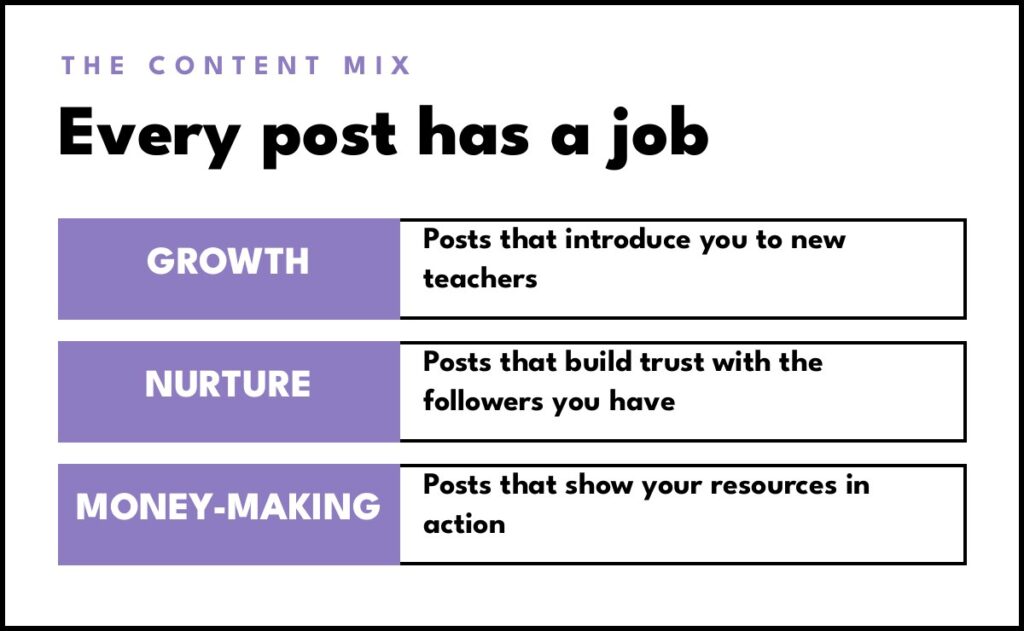
Most teacher Instagram accounts run on three kinds of content, whether the teacher planned it that way or not. Planning it makes all the difference.
- Growth content is made for the people you want to reach. It’s crafted to catch the attention of teachers who don’t know you yet.
- Nurture content is for the people who already follow you. They don’t need convincing to follow you again. They need interaction: engagement, conversation, answers to their questions.
- Money-making content points people toward one of your income streams.
Before you can make growth content, you need one of two things clear: what you want to be known for, or who you want to reach. One of the two is enough. When I started, I didn’t have the “known for” part figured out at all. I knew I wanted to reach math teachers and make their lives easier somehow, and that was enough to build a strategy on.
Money-making content is where teachers get nervous, because they picture the hard sell. It doesn’t have to look like that. A haul of your favorite classroom finds, a review of something you use and love, a how-to that teaches a strategy: all of that can carry a link and still feel like help, because it is help.
Compare that with the post every teacher seller has made at some point: a photo of a resource cover with “I just created this, it’s in my TpT store, go buy it.” Nobody wants to be sold to that directly. Show the resource being used in a real classroom instead. Share how your students reacted and what problem it solved. Teachers start asking how they can get it. You’ve created the trust first, and the sale follows on its own.
Instagram for TpT Sellers: Turning Scrollers Into Store Traffic
If you sell on Teachers Pay Teachers, Instagram is probably your best source of buyers who already trust you before they ever land on your store page. But it only works if your content speaks to buyers.
That means your posts should be about your resources in real classrooms, not about making resources. A math seller’s strongest content is things like the best printable and digital resources she’s used with real students, how she engages her most reluctant learners, and mistakes she sees in the math classroom and how to fix them. That is what a teacher shopping for math resources searches for, saves, and shares.
When it’s time for money-making content, show the resource in use and let teachers ask where it came from. When you give away a freebie, you’re handing out the food court sample: a teacher tries it on Monday, it works, and your whole store looks more trustworthy by Friday. And keep an eye on your advocates, the teachers who always comment and share your posts. They are the main drivers of word of mouth for your TpT store, and the followers they send you arrive already believing your resources are good.
Never Stuck: 10 Things to Post When You Don’t Know What to Post
Every teacher seller hits the week where the ideas run dry. Keep this list somewhere close:
- Reintroduce yourself. New followers have arrived since the last time, and the rest need a refresher on who you are and what you do.
- Share facts and tips about your niche. This is how you become the expert people come to with questions.
- Share a free resource. Show it off, point to your bio, and let it build your email list while it builds trust.
- Share a struggle. You’re human, and your audience connects with the overwhelmed weeks as much as the wins.
- Post a throwback. An early resource, a bestseller, a photo from your first year teaching. New followers missed all of it the first time.
- Share a favorite classroom find. Teachers love a cheap, clever find. Post the gadget before someone else does.
- Answer a question you always hear. Pose the question your niche asks constantly, then answer it in a caption, Reel, or carousel.
- Share a win from the week. A new resource, a kind testimonial, a fear you got past. Positivity is content too.
- Ask for advice. Your audience gets to help you, engagement rolls in, and you find out who’s an expert in what.
- Make a Reel of something you’re working on. On camera if you’re comfortable, faceless if you’re not. Both work.
Feed this list with a Reels idea bank: a running note on your phone where you save ideas and links to Reels you could adapt to your niche. Trends tend to start on TikTok and migrate over, so when you see one that fits your audience, save it before you need it. Coming up with ideas on the spot, right before you film, is how posting stays hard.
Why Your Teacher Instagram Isn’t Growing: 3 Mistakes
If you’re posting consistently and still not growing, one of these is usually the reason.
Mistake 1: Following hacks instead of humans. The hacks rotate every year. Stretching carousels to ten slides so people spend longer on the post. Using all 30 hashtags. The perfect feed aesthetic, circa 2017. Engaging for exactly 30 minutes before and after posting, which is advice I used to give myself, many moons ago. Some of these sort of made sense once. Instagram has changed since then, and padding a carousel to ten slides doesn’t make anyone spend time on your post. Making the post genuinely interesting does. We are creating content for people, not algorithms. Before you stretch a piece of content, ask whether your ideal follower will like it or be annoyed by it.
Mistake 2: Making content for you instead of your audience. Behind-the-scenes content feels fun to make: how you design your resources, your creation process, how you built your course. But that content attracts other sellers, your competition, instead of your customers. Your content pillars should come from what your buyers want to see, the way the math seller example above works. There’s room for your personality and your story. It just can’t be the whole feed.
Mistake 3: Comparing yourself to others. Knowing what’s happening in your niche is useful in moderation. Scrolling other sellers’ profiles and sulking instead of creating is not. The teachers you’re comparing yourself to may not even be on your followers’ radar. They follow you for you. Spend that time talking to your audience and finding out what they want instead.
The Don’ts: Quiet Habits That Suppress Your Account
Some strategies feel like shortcuts and work like anchors.
Careless tagging. Tagging people gets eyes on your post, and tagging people in content that has nothing to do with them reads as spam. It frustrates the person tagged and can cost you followers who were genuinely interested. If you wouldn’t want to be tagged in it, don’t tag someone else in it.
Inauthentic commenting. The emoji-only comment. Liking every comment on someone else’s post to get noticed. Pitching your own account in another teacher’s comment section. Everyone can spot it, and it builds nothing. Now picture the other kind of comment: “I totally understand this. Your resource would really help teachers out. I especially loved the real world example because my students always struggle with this.” That person read the caption and looked at the content. That’s who gets checked out and followed.
Asking for follows. Follow-for-follow, follow loops, and follow trains do grow your count, quickly. Then the bill comes due. Your account fills with people who don’t care about your content, never engage with it, and never buy. An account full of followers who never engage sends Instagram weak signals about your content, so less of it gets shown to anyone. It also looks off to real visitors: 15k followers and three likes per post reads as a spam account. I would rather have 100 truly engaged people who support my business over 100k followers who never engage or care about what I have to say.
Connections Are the Strategy
Teachers spend the first weeks of school building connections before they teach much content, because students learn more from teachers they trust and believe care about them. Instagram runs on the same principle. Followers who feel a real connection with you are the ones who buy, and the ones who recommend you.
Respond meaningfully. “Love this!” is the cookie-cutter comment everyone recognizes. Meaningful looks different: read the caption, answer the question it asked, say specifically what landed with you and why. Do the same in Stories and DMs. It takes longer per comment. It’s also the whole game.
Talk to the individual. Greeting each student by name at the door builds a different classroom than a “hello everyone” called out from your desk. Your Stories and Lives work the same way. Say “you” instead of “everyone,” and the one person watching feels like she’s having a conversation with a friend, because she is.
Start conversations in DMs the warm way. Instead of cold DMing people, reply to their Stories with a genuine comment or reaction. You’re responding to something they chose to share, which makes it a conversation starter instead of an interruption.
Show your face. People connect with people. Show up in your Stories, talk to the camera, share a funny classroom story. If you’re camera shy, start smaller: a still photo of your face with a wrap-up of your day still counts. And faceless Reels, where your resources are the star, are a perfectly good format. The point is that people know who is behind the products.
Be patient and nurture it. Classroom relationships take weeks and months, not two days. So do these. Keep commenting, keep showing up in Stories, keep answering. Over time your audience trusts you, invests in what you make, and recommends you to their friends. It builds slowly, and then it compounds.
Build a Community, Not Just an Audience
An audience is one-to-many: you talk, they listen. A community is many-to-many: your followers are connected to each other, through you, by shared interests and goals. Communities last longer than audiences, because a follower who has made friends through your content doesn’t drift off to the next account. She sticks around, engages, and eventually buys, because she’s part of something.
Set the culture. Your content has a vibe and values, the same way your classroom did. Express them plainly and consistently. The right people will recognize themselves and settle in. The wrong people will wander off, and that’s fine. Losing a follower or two while the right ones find you is part of the process.
Give followers each other. Ask them to introduce themselves in the comments, and encourage them to reply to each other, not just to you. Post an interactive Reel with get-to-know-you questions and invite followers to answer back, in their own Reel or right in the comments, then share their answers in your Stories. If you send an email newsletter, a weekly subscriber shout-out does the same job there: feature a different reader each week and let your people find each other.
Find your advocates and keep them close. Your advocates are the ones who like everything, comment often, watch your Stories, and send DMs. Go through your past posts and DMs and identify them, and when you have ten spare minutes, engage with those people on purpose. They share your content, they tell other teachers about your resources, and the followers they send you are the loyal kind.
Let the community shape the offers. Sell what fits your community’s values and needs, and ask them what they’re struggling with before you build it. Involve them, and they feel heard, and you build things you already know will sell. Then ask for testimonials and make it easy to share, because a recommendation from inside the community carries more weight than any ad.
Here’s the section as a to-do list:
- Write down the values and vibe your content stands for, and keep them in front of you when you create.
- Prompt followers to introduce themselves and talk to each other in your comments.
- Post interactive content that invites followers to answer back, and share their answers.
- Feature a subscriber or follower regularly so your people meet each other.
- Build offers around what your community actually needs, with their feedback in the loop.
- Encourage testimonials and referrals, and thank the people who give them.
- Stay consistent. Community is built in months, and it’s worth every one of them.
Keep Up Without Burning Out
Instagram changes constantly, and your strategy has to change with it. When a new feature rolls out, the teachers who try it early tend to get an edge while the platform promotes it. You don’t have to chase every update the day it drops. You do have to know updates happened.
Follow Adam Mosseri, Instagram’s head, and Instagram’s Creators account for platform news. Mosseri posts most often on Threads. A quick check-in with those two sources beats a week of reading panicked takes about the algorithm.
The other half of keeping up is boring and effective: a content calendar. Teachers have the best intentions about posting, and then the school day happens. Plan your posts in advance, with the actual words written out, and consistency stops depending on whether you remembered at 9 p.m. Intention plus a calendar is how this survives a full school year.
Frequently Asked Questions
Why is my Instagram not growing even though I post every day?
Because posting every day and posting with intention are different things. If your content doesn’t relate to your niche and ideal audience, or it’s mostly behind-the-scenes content aimed at other sellers, daily posting just repeats the problem daily. Give every post a job (growth, nurture, or money-making), build your pillars around what your buyers want, and growth follows the clarity.
How many hashtags should I use on a post?
A few, and make them specific. Five or six hashtags that describe exactly what the post is and who it’s for will do more for you than a block of 30 generic ones, and the giant hashtag block never added distribution anyway. Treat hashtags as one part of your Instagram SEO: they help categorize you, alongside your name field, bio, and captions.
Do follow trains and follow-for-follow loops actually work?
They work at raising your follower count and at very little else. The followers you gain don’t care about your content, rarely engage, and never buy, and an account full of non-engaged followers sends weak signals that get your content shown less. A hundred engaged followers are worth more to your business than a hundred thousand empty ones.
Do I need thousands of followers to make sales?
No. Sales come from trust and community, not from the number at the top of your profile. A small group of teachers who know you, engage with you, and believe your resources help them will buy. A huge audience of strangers who followed you in a loop won’t. Build for the first group.
What should I post when I have no content ideas?
Start with the list in this guide: reintroduce yourself, share a niche tip, post a free resource, answer the question you always hear, share a win or a struggle. And keep a running idea bank on your phone so the dry weeks get rarer. Being stuck usually comes down to planning, and an idea bank is the fix.
I’m camera shy. Do I really have to show my face?
You have to be a person, which is slightly different. People connect with people, and a face builds trust faster than a logo does. Start where you can: a still photo of you with a note about your day, or your voice over your resources. Faceless Reels are a legitimate format. As you get more comfortable, talk to the camera in Stories. Small steps count.
How do I sell on Instagram without feeling salesy?
Lead with help. Most of your posts should solve a problem or fill a need for your ideal teacher, which builds the trust that makes selling feel like a conversation. Give away a free resource like a food court sample, so teachers can see your work fixes their problem. Then, when you share a product, show it in a real classroom and let teachers ask how to get it, instead of posting the cover with “go buy it.”
I’m a TpT seller. Does Instagram actually send buyers to my store?
Yes, when your content is aimed at buyers: your resources in real classrooms, answers to the questions your buyers ask, and freebies that prove your work helps. Your advocates do a lot of the carrying here, because their recommendations send you followers who already trust you. Instagram rarely sends you a cold stranger who buys on the spot. It sends you a teacher who has watched you help her for weeks. That teacher buys.
What is Instagram SEO?
Instagram SEO is the strategy you use to be easily discovered on Instagram, and to help Instagram categorize your content so it reaches the right teachers.
Get the Whole System, Step by Step
This guide is the map. If you want the system itself, with the profile setup, the content planning, and the follower-to-buyer strategy laid out in order, that’s exactly what I built Teachergram Toolkit to be: the step-by-step Instagram system for teacherpreneurs who want to grow with strategy instead of stress.
And whichever route you take, start the email list. Social media isn’t guaranteed, and you don’t control Instagram’s decisions. You do control your email list, and those are the people you can always reach. Join my email list and I’ll send you the teacher-business strategies I’m not posting anywhere else.
Your followers were never the point. The teachers behind the number are. Build for them, and the buyers take care of themselves.
